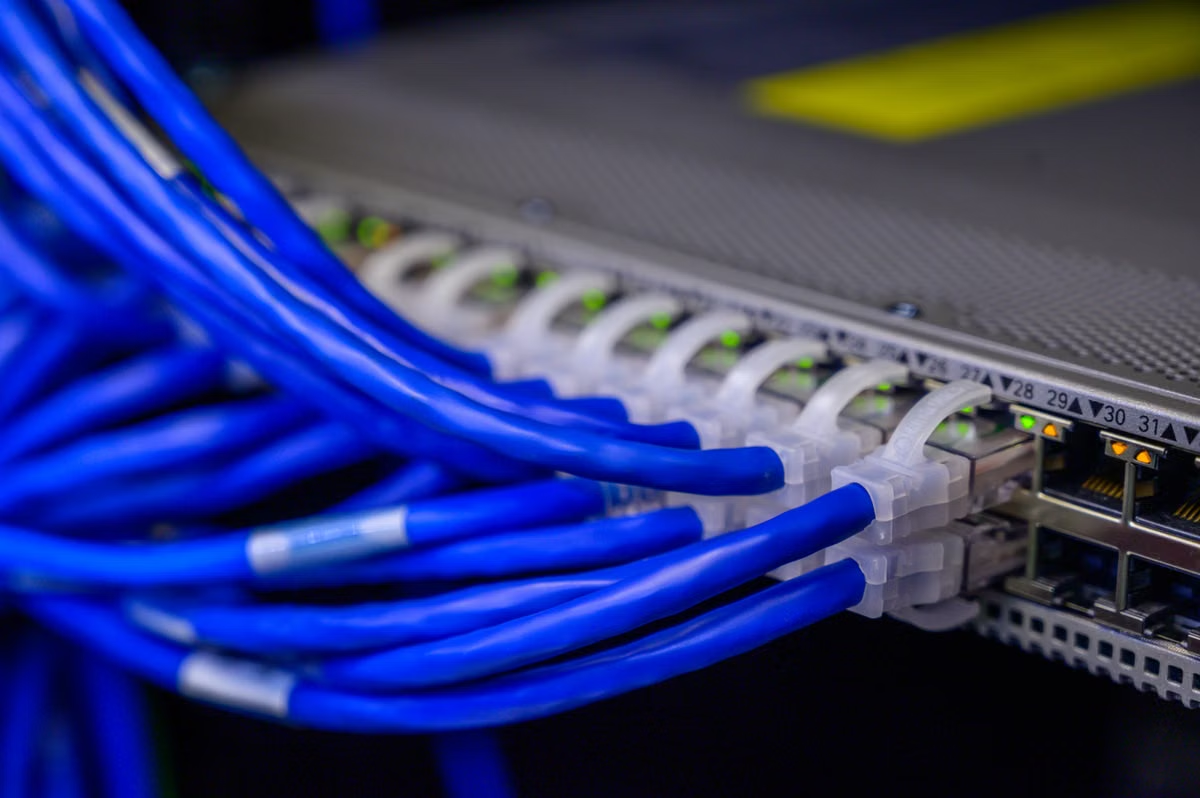
The release of Meituan’s LongCat-2.0 on July 6, 2026, represents a tectonic shift in the AI infrastructure landscape. Training a 1.6 trillion parameter Mixture-of-Experts (MoE) model is no longer the exclusive domain of NVIDIA’s CUDA ecosystem. By leveraging a massive cluster of 50,000 domestic GPUs coordinated by the Huawei Collective Communication Library, LongCat-2.0 achieved a SWE-bench Pro score of 59.5, surpassing GPT-5.5. The success of this project hinges not just on raw FLOPs, but on solving the catastrophic communication overhead inherent in 50,000-node distributed systems.
1. The Scaling Wall: Why 50,000 Nodes Break Traditional Networking
In high-performance computing, the leap from a 1,000-card cluster to a 50,000-card cluster is not linear; it is exponential in complexity. When you exceed the 10,000-card threshold, the primary constraint shifts from "compute-bound" to "communication-bound." This is the "Scaling Wall" that defines modern AI training.
The LongCat-2.0 training principle focuses on maintaining high GPU utilization (MFU) across a heterogeneous environment. At this scale, the traditional "All-Reduce" operations used in data parallelism encounter a distributed computing bottleneck where the time spent waiting for gradient synchronization exceeds the time spent on the forward pass.
Key challenges faced at the 50,000-card scale include:
1. Tail Latency Amplification: In a synchronous training step, the entire cluster moves at the speed of the slowest GPU. A single dropped packet in a 50,000-node network can stall the entire 1.6T parameter update.
2. Topology Complexity: Mapping 50,000 cards into a non-blocking fabric requires sophisticated multi-rail network designs that standard libraries cannot efficiently handle.
3. MoE All-to-All Storms: LongCat-2.0’s MoE architecture requires "All-to-All" communication to route tokens to different experts. Without specialized optimization, this creates a massive congestion point at the top-of-rack switches.
2. Hardcore Architecture: Huawei Collective Communication Library in Action
The Huawei Collective Communication Library (HCCL) serves as the "nervous system" for the LongCat-2.0 cluster. Similar to NVIDIA’s NCCL, but optimized for domestic silicon interconnects like HCCS and RoCE v2, it provides the low-level primitives necessary for the AI training network optimization.
Topology-Aware Routing
The Huawei Collective Communication Library implements a topology-aware strategy that is crucial for a 50,000-card deployment. Instead of treating the network as a flat entity, HCCL recognizes the hierarchical structure: intra-chip, intra-server, and inter-cabinet. It prioritizes data movement within the highest bandwidth lanes, significantly reducing the pressure on the spine switches.
Adaptive Communication Algorithms
For LongCat-2.0, researchers utilized HCCL's adaptive algorithms that switch between Ring, Tree, and Recursive Halving/Doubling patterns based on the message size and the current congestion state of the 5万-card fabric. This flexibility ensures that the 1.6 trillion parameters are synchronized with minimal overhead.
| Feature | Standard MPI/NCCL | Huawei Collective Communication Library (HCCL) |
|---|---|---|
| Cluster Scale | Optimized for <10k nodes | Proven at 50,000+ nodes (LongCat-2.0) |
| Fault Tolerance | Manual checkpointing | Dynamic node isolation & fast recovery |
| MoE Support | Generic All-to-All | Expert-to-node mapping optimization |
| Hardware | Proprietary (NVIDIA/Intel) | Optimized for Domestic/Huawei Silicon |
3. Solving the MoE Communication Crisis
LongCat-2.0 is a Mixture-of-Experts (MoE) model. Out of its 1.6 trillion total parameters, only about 48 billion are activated per token. While this reduces the compute requirement, it introduces a nightmare for the 国产算力集群扩展性 (scalability of domestic compute clusters).
In a MoE setup, tokens must be "dispatched" to specific cards where "experts" reside. This triggers an All-to-All communication pattern. If 50,000 cards all try to send data to each other simultaneously, the network collapses.
To solve this, LongCat-2.0 employs "Expert Parallelism" combined with the Huawei Collective Communication Library's group-based communication. Instead of a global All-to-All, the cluster is divided into "Expert Groups." Routing happens primarily within these groups, and only a fraction of tokens cross the group boundaries. This architectural decision, backed by HCCL's streamlined primitives, kept the communication overhead below 15% of the total training time.
4. Stability and Resilience in Large-Scale Training
When training on 50,000 cards, the Mean Time Between Failures (MTBF) is incredibly short. Hardware failures are a daily occurrence, not an anomaly.
The LongCat-2.0 team utilized HCCL's "Deterministic Communication" and fast checkpointing features. If a node fails, the library can instantly reconfigure the logical topology. Unlike traditional setups where the whole job crashes, the Huawei Collective Communication Library allows the cluster to "bypass" the faulty node and resume from the last micro-batch rather than the last global checkpoint.
Technical data points for LongCat-2.0 stability:
* Checkpoint Time: Reduced from minutes to seconds through parallel I/O and HCCL-coordinated data dumping.
* Effective Training Time: Maintained at >92% despite the massive node count.
* Latency Consistency: P99 communication latency kept within 5% of the median, preventing "straggler" nodes from slowing down the 1.6T parameter flow.
5. Operations: Remote Management and Real-time Monitoring
Managing 50,000 GPUs is an operational challenge that requires more than just a CLI. Engineers frequently need to visualize gradient flows, monitor thermal throttling across cabinets, and debug the Huawei Collective Communication Library logs in real-time.
Using a high-performance remote access solution like a Mac mini M4 cloud for the management console provides the necessary stability for long-running AI training sessions. These dedicated environments allow AI architects to run heavy visualization tools (like TensorBoard or customized HCCL profilers) without interfering with the Linux-based head nodes of the domestic cluster.
Many engineers prefer a dedicated mac-mini-m4-cloud-order-us-west or similar high-performance node to act as a stable jump host. This setup provides a low-latency graphical interface for monitoring the LongCat-2.0 training progress, especially when dealing with complex logs that track the 100-million-token context window's performance.
6. How LongCat-2.0 Redefines AI Infrastructure
The move away from a "compute-only" mindset toward a "communication-first" mindset is the real lesson of LongCat-2.0. Achieving 59.5 on SWE-bench Pro proves that domestic hardware, when unified by a robust library like the Huawei Collective Communication Library, is a viable path for frontier AI.
However, building and debugging these models requires a flexible development environment. Relying solely on local hardware or shared cloud instances often leads to "environment drift" and version conflicts. While the training of LongCat-2.0 happens on 50,000 specialized cards, the development and monitoring of such models are increasingly moving toward stable, high-performance remote workstations.
If you are an AI architect currently struggling with the constraints of standard cloud VMs or unoptimized hardware, consider the benefits of a dedicated environment. Traditional virtual desktops often lag when dealing with the high-bandwidth data streams of a 50,000-node cluster. Using specialized hardware for your management tier, such as a rented Mac for its superior screen-sharing protocols and Unix-native stability, ensures that you are never "flying blind" during a multi-million-dollar training run.
Experience the future of AI management with meshlaunch.com. Secure your dedicated high-performance environment today to monitor your next-generation models with the reliability that a 1.6T parameter model demands. Whether you are debugging HCCL logs or orchestrating a massive pod of domestic cards, our infrastructure provides the professional-grade stability your workflow requires.